Overview
Key Features
-
Real-Time Error Tracking
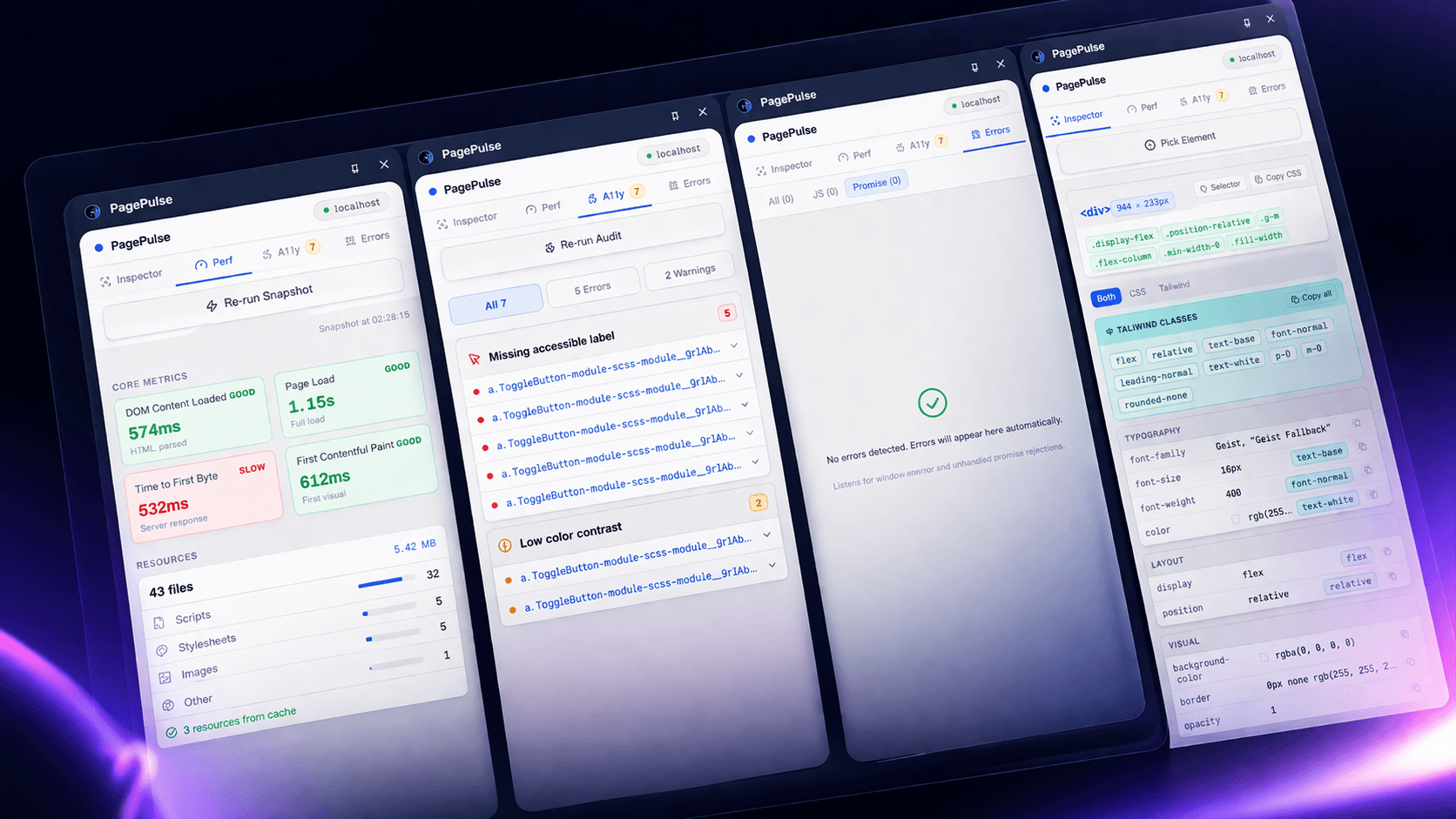
Captures JavaScript runtime errors and unhandled promise rejections using global event listeners. Errors are structured and sent to the extension for analysis and display. -
Interactive DOM Inspection
Enables element-level inspection with a visual overlay system. Users can hover and select elements to extract structured data such as styles, layout dimensions, attributes, and hierarchy. -
Computed Style Extraction
Uses the browser’s CSSOM APIs to retrieve computed styles and present them in a readable format, helping developers understand how elements are rendered. -
Performance Insights
Leverages the Performance API to extract metrics such as page load time, Time to First Byte (TTFB), and resource loading behavior. -
Accessibility Analysis
Performs rule-based accessibility checks, including:- Missing alt attributes
- Missing form labels
- Incorrect heading hierarchy
- Low color contrast
-
Lightweight Architecture
Designed to run entirely within the browser without external APIs, ensuring fast performance, reliability, and privacy.
Technologies Used
-
Chrome Extension (Manifest V3)
Core platform enabling browser-level integration and event handling. -
JavaScript (ES Modules)
Used for building modular and maintainable logic across content scripts and background processes. -
Chrome APIs
- runtime for messaging
- tabs for tab-level control
- storage for state persistence
- sidePanel for UI rendering
-
DOM & CSSOM APIs
For element inspection, attribute extraction, and computed style analysis. -
Performance API
For capturing navigation and resource timing data.
Challenges and Learnings
Outcome
This project highlights the ability to design and implement real-world systems that operate at the browser level, focusing on performance, usability, and practical problem solving.